
OEM, ODM, EMS, CEM Explained: Make the Right Choice Fast
Choosing the right electronics manufacturing partner can make or break your product launch. But with so many acronyms, OEM, ODM, EMS, and CEM, it’s easy to get confused.
In this guide, we break down exactly what each term means, how they differ, and which model is best for your product, budget, and IP strategy. Whether you’re a startup or an established company in the UK, this guide will help you make the right decision fast, avoid costly mistakes, and protect your intellectual property.
Why Understanding OEM, ODM, EMS, and CEM Matters
The terms OEM, ODM, EMS and CEM are commonplace in the electronics manufacturing industry. This reflects the rapid growth and fragmentation of electronics production, driven by digitalisation and global connectivity.
More companies are outsourcing electronics manufacturing services, making it essential to choose the right partner. Selecting the wrong model can lead to higher costs, slower time-to-market, or even IP risks.
Understanding the differences means you can:
- Protect your product’s IP and design rights
- Reduce development and manufacturing costs
- Scale production and efficiency
- Choose the best partner for your unique product
What is an OEM, an ODM, an EMS and a CEM?
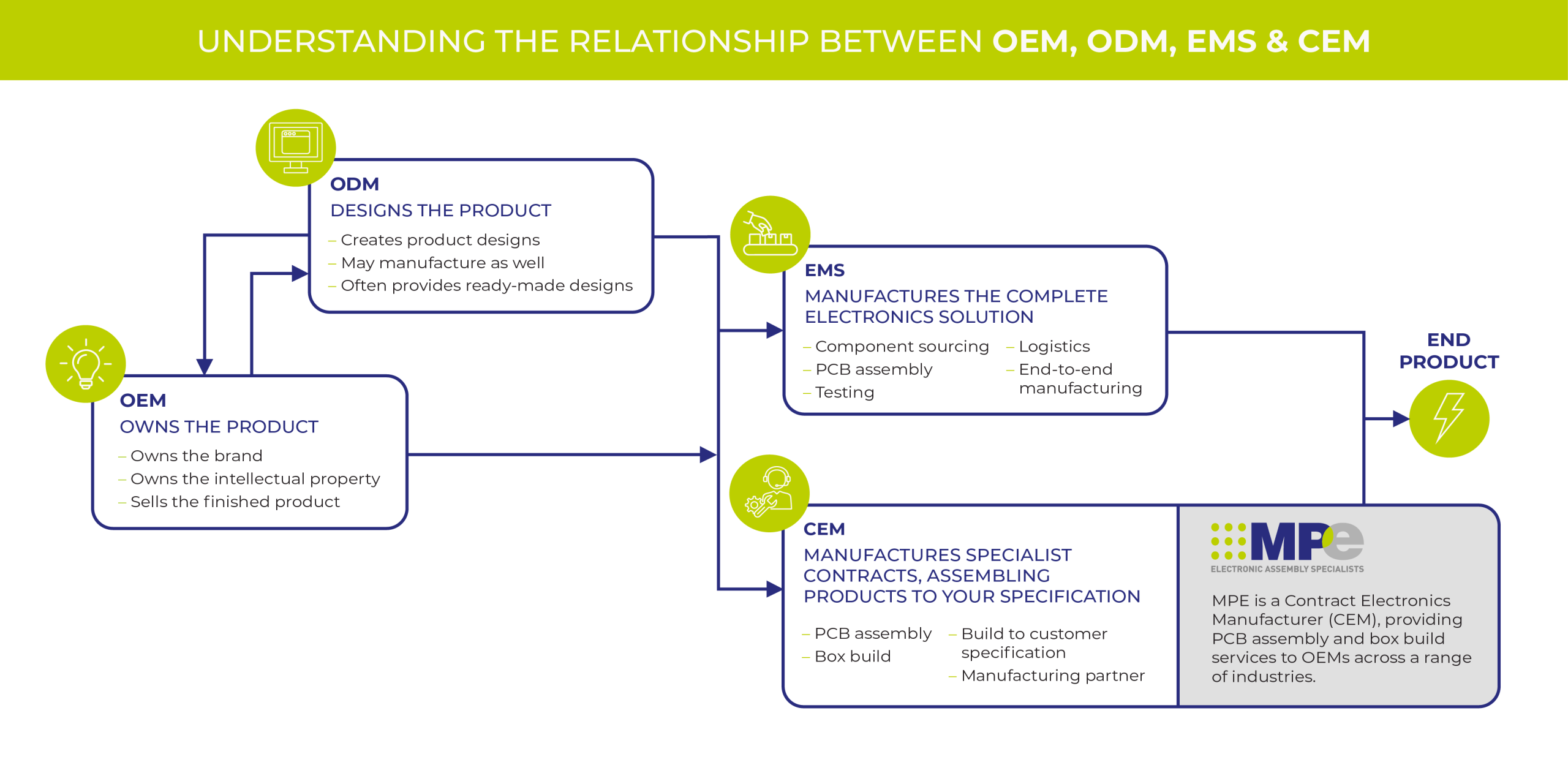
To help you make the right decision and select the correct manufacturing partner, we have created this quick guide to OEMs, ODMs, EMSs and CEMs, and what they do:
What is an OEM?
OEM stands for Original Equipment Manufacturer.
- OEMs design and manufacture their own products, retaining full intellectual property (IP) ownership.
- Some OEMs outsource parts or assembly to partners, like MPE Electronics, but maintain design control.
- OEMs are best for companies developing unique products where brand control and IP protection are crucial.
Example: Apple designing the iPhone and contracting assembly to a manufacturing partner.
What Is an ODM?
ODM stands for Original Design Manufacturer.
- ODMs design and manufacture products that are then rebranded and sold by another company.
- They often focus on specific product types, holding the IP for these designs.
- ODMs are ideal if you need speed to market and lower development costs.
Example: Foxconn designing and making electronics for multiple global brands.
What Is an EMS?
EMS stands for Electronics Manufacturing Services.
- EMS providers offer full lifecycle electronics manufacturing services, including:
- Product design and prototyping
- Assembly and testing
- Supply chain management and logistics
- Repair and post-production support
- EMS is ideal for OEMs needing large-scale production and complex assemblies.
What Is a CEM?
CEM stands for Contract Electronics Manufacturer.
- CEMs focus on manufacturing and assembly of products based on designs provided by clients.
- Unlike EMS providers, CEMs typically don’t handle software or design services.
- CEMs are perfect for high-spec assembly projects where speed, quality, and consistency are critical.
OEM vs ODM vs EMS vs CEM: Key differences
Choosing the wrong model can increase costs, delay product launch, or compromise IP. Understanding the key differences can help you make the right choice.
| Feature | OEM | ODM | EMS | CEM |
|---|---|---|---|---|
| Design Ownership | You | ODM Partner | You (usually) | You |
| IP Ownership | You | ODM | You | You |
| Manufacturing | Owns / Partners | Owns / Partners | Outsourced | Outsourced |
| Services | Full Service | Design + Build | End-to-End Lifecycle | Assembly Only |
| Best For | Unique Products | Speed & Cost | Full Outsourcing | High-Spec Assembly |
Why Choosing the Right Manufacturing Partner Matters
Selecting the correct partner ensures:
- IP protection: OEMs and ODMs differ in who owns the design.
- Speed to market: ODMs can reduce development time; EMS ensures scalable production.
- Cost efficiency: Outsourcing smartly lowers overall production costs.
- Quality & compliance: CEMs specialize in precision assembly and regulatory adherence.
“The right choice between OEM, ODM, EMS, and CEM can make all the difference to a project’s success. It’s about aligning your goals with the partner that can deliver them,” explains Paul Carter, Sales Director at MPE Electronics.
FAQs
What is the difference between OEM and ODM?
OEM designs and manufactures its own products, while ODM designs and manufactures products that are rebranded by other companies.
When should I choose EMS vs CEM?
EMS is best for full lifecycle production, including design support. CEM focuses on contract assembly of products designed by the client.
How do I pick the right electronics manufacturing partner?
Evaluate your IP ownership needs, cost constraints, product complexity, and timeline to determine whether OEM, ODM, EMS, or CEM is the best fit.
Where does MPE Electronics fit into the electronics manufacturing landscape?
MPE Electronics is a contract electronics manufacturer (CEM) providing printed circuit board assemblies (PCBAs) and electronic assemblies. OEMs and Tier 1 manufacturers across the industry rely on MPE for high-quality assembly, speed and cost-effective solutions.
Want to know more about how a CEM works? Our blog covers:
- How to create a partnership with a CEM
- The right time to involve a CEM in your product manufacturing process
- How to tell if your CEM partnership is performing successfully
For more information on MPE Electronics PCB and product assembly services, contact us on +44 (0)1825 764822 or enquiries@mpe-electronics.co.uk.
Are you looking for your next contract electronics manufacturing partner?
Submit an enquiry and one of our experts will guide you to the right OEM, ODM, EMS, or CEM solution for your product.
